
If you prefer video content over text, I explain this material with fun, musical examples in my YouTube video.
In visuals, we use color to draw attention to the most important element:
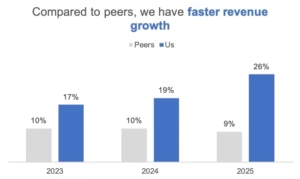
How can we do the same with our voice in speech?
In this article, I break down how to use volume to push and pull attention where we need it the most.
What Not To Do
Consider this sentence:
“Before I knew it that meeting was over. People were starting to leave the room. And I sat there thinking to myself “I didn’t say a word”
Imagine that said with a flat, factual, monotone voice. It would be incredibly boring … like a painting with a single color.
Just like art and music, communication requires contrast – to indicate what material requires intensity and excitement, and what material requires quiet contemplation.
What To Do
Check out how Jessica Chen, bestselling author of “Smart Not Loud,” tells her story:
She delivers the story with all the changes in dynamics indicated below:
- [Loud] “Before I knew it”
- [Soft] “That meeting was over. People were starting to leave the room”
- [Louder] “And I sat there just think to myself”
- [Softer] “I didn’t say a word”
The contrast between loud and soft makes you pay attention … like a painting with contrast between light and dark.
- [Loud] “Before I knew it” makes you go: “Woah, what comes next?!”
- [Soft] “That meeting was over. People were starting to leave the room” makes you think: “Oh, oh no. This is a missed opportunity”
- [Louder] “And I sat there just think to myself” makes you go: “Uh oh, what’s she about to say?!”
- [Softer] “I didn’t say a word” makes you think: “Ah, that’s a shame”
Of course, don’t just speak louder and softer in rapid succession for the sake of variety. It’s when you use this technique purposefully that people listen carefully and changes in volume enhance your message.
Summary
When you want to highlight an important point, say it louder than your previous words.
When you want to make people sit in a moment and consider it deeply, say it softer.
Great speakers, like great artists and musicians, use contrast to heighten meaning.
If you’re looking for further guidance on how to differentiate your communication skills and stand out in the workplace, take my free self-assessment.
I’m writing a book on thinking quickly, speaking clearly, presenting convincingly, and supercharging your executive presence. My current focus: a section on how to persuade without force. This will be a psychological primer on assertion and what techniques are the most successful for convincing a resistant audience.
Follow me on LinkedIn for more updates on the book and its release!