If you prefer video content over text, I explain this material with fun, musical examples in my YouTube video.
Humor is so hard to do in public speaking.
You might think you’re killing it up there. But all your jokes might be dying on impact.
In this article, I break down how to do humor right when you present, so you don’t unintentionally offend everyone:
What Not To Do
According to the benign violation theory of humor, something is funny if it’s a “benign violation.”1
Let’s break that down:
“Violation” means you contradict someone’s expectations.
For example:
- You’re sitting with headphones in, and expect no one to talk to you. Then someone grabs your phone.
- You go up to stage and people expect you to speak. But you slip and fall.
Both those examples are violations but they’re not funny. Because they’re not “benign”.
“Benign” means your audience perceives the violation as a false alarm. They don’t consider it to be dangerous or distasteful.
For example:
- You’re sitting with headphones in, and expect no one to talk to you. Then someone grabs your phone … and replaces it with a more expensive one.
- You go up to stage and people expect you to speak. But you slip, fall … and do a little dance on the way back up.
The joke sets itself up to be a violation at the beginning. Then the “punchline” at the end sucks the danger out, so you perceive it as benign.
A joke that is too benign or too much of a violation therefore isn’t funny. You need to hit the “sweet spot” in between.
What To Do
Consider this case study. You’re a public speaker who specializes in presentation skills. You’re explaining to an audience what “bad slides” look like in their company, and you show them this bad slide they made:

You want to make the audience laugh. So you plan to say, “I realized where this slide’s inspiration came from” and reveal a funny image. Let’s go through three options you could use:
Option 1:
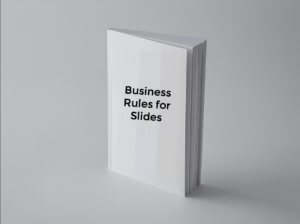
It’s not funny. Because it doesn’t violate expectations. We all know the slide was probably inspired by company templates and guidelines.
Option 2:

Think about the audience. What you’re saying with this image is their slides are as bad as s***. That may be funny to you. Not funny to them – because it’s not benign and hurts their ego.
Option 3:
This is the image Garr Reynolds, bestselling author of “Presentation Zen,” uses to make his joke:

His live audience cracks up because it’s a violation of expectation (no one saw that coming). And it’s benign. Garr’s point is that “bad slides” have too many flashy things going on, just like kid’s cereal boxes.
You can watch Garr deliver the full joke in the video below. He gets to the punch line about 30 seconds into the clip:
Summary
To be funny during your presentations, take the time to understand your audience. Understand what they consider to be a violation and what they consider to be benign. Err on the side of caution, since this is a professional environment, and people may have different cultural, societal, and professional expectations for what is acceptable.
But manage to hit that “sweet spot” of humor, and your audience will adore you.
If you’re looking for further guidance on how to differentiate your communication skills and stand out in the workplace, take my free self-assessment.
I’m writing a book on thinking quickly, speaking clearly, presenting convincingly, and supercharging your executive presence. My current focus: a section on enhancing storytelling with emotional expression. This will be a deep-dive into identifying the right emotion that moves your audience from resistant to receptive.
Follow me on LinkedIn for more updates on the book and its release!