

If you prefer video content over text, I explain this material with fun, musical examples in my YouTube video.
Slides do not have to look fancy and complex to be effective.
The more you add, the more you can actually detract from the audience experience.
In this article, I break down the proper relationship between speech and slides in presentations:
What Not To Do
Consider what slide you would use to present this material:
“A social smile or a polite smile is when you’re not really feeling the happiness. A Duchenne smile is when you have crinkled eyes lifted creeks and an upturned smile so the whole face is working”
Would it be something like this:
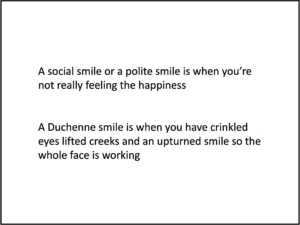
Logically, it makes sense. In case you forget what to say, it’s all right there.
But think about how it feels for your audience:
- They see the slide go up
- They focus on reading it, ignoring you
- They finish reading it, then hear you repeat the exact same thing.
You have made yourself redundant. There’s literally no point in you being up there. People could get an email with the slides and read all this information faster than you could say it.
What To Do
Check out how Lorraine Lee, bestselling author of “Unforgettable Presence”, presents this material:
The audience sees Lorraine’s slide go up:
- They “get it” without explanation because it’s just images, no text.
- As Lorraine goes on to verbally explain the difference between the two smiles, the audience has the freedom to briefly look back at the slide to confirm her message.
This experience is something an email could not replicate. While an email would be fast, it would be dry and boring.
Here, Lorraine uses her presence and expertise to make the material come to life. She uses slides to complement her words, thereby reinforcing her points instead of mindlessly repeating them. In this way, the audience receives a complete visual and verbal experience that will be difficult to forget.
Summary
Do not use slides as crutches for your memory.
Use them as simple visual support that complement your words, instead of supplanting your expertise.
If you’re looking for further guidance on how to differentiate your communication skills and stand out in the workplace, take my free self-assessment.
I’m writing a book on thinking quickly, speaking clearly, presenting convincingly, and supercharging your executive presence. My current focus: a section on speaking naturally and effortlessly. This will be a deep-dive into “flow state” – the state of peak mental performance athletes, speakers, coders, (literally anyone) can enter if they satisfy certain psychological requirements.
Follow me on LinkedIn for more updates on the book and its release!